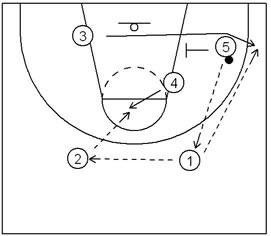
Run this set against a 2-3 zone.
Even if your personnel will not allow you to run this zone attack all the way through, there are several really good cuts and movements that you can incorporate into what you do.
This was put together by Coach Creighton Burns.
He has made coaching stops in four states including Georgia, Indiana, Kentucky, and Michigan at both the high school and college levels.
Coach Burns has coached both Men and Women.
Creighton has received numerous coaching honors including Indiana Basketball Coaches Association Coach of the Year in 1988.
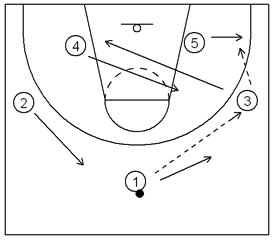
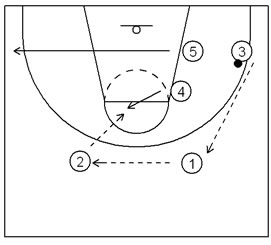
The offense starts in a 1-2-2 alignment, but becomes a two guard front attack.
#1 throws to a wing, #3.
#3 passes down to #5 who has moved out toward the ballside corner.
#1 and #2 move to fill the traditional two guard front spots.
#4 flashes to the ball side elbow area.
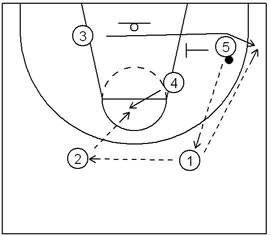
#5 passes out to #1 and screens in for #3 who uses the screen and cuts to the corner.
#1 can pass fake to #2 and throw back down to #3 , or he can make the pass over to #2.
On the pass to #2 , #4 flashes toward the ball.
When #2 catches he looks first to ge t the ball to #4 on the flash.
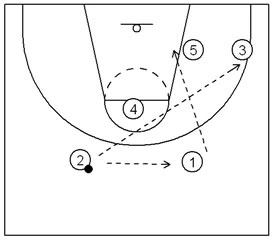
If #4 is not open , #2 will look to throw the skip pass to #3.
#3 can catch and shoot if open, or look into #5 , who sets the screen and posts up.
If #2 chooses to pass to #1 , #1 can catch and if the defense has cheated he may make a direct pass to #5 for a shot opportunity.
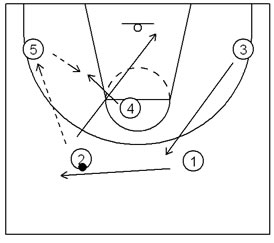
If #3 does not have a shot, or cannot get the ball to #5, he will start ball reversal by passing to #1.
#1 wil l swing the bal l to #2.
Again, #2 catches and looks first to #4 in the post.
When #5 sees the start of the ball reversal, he cuts hard to the back side corner.
If #4 is not open , #2 will make a pass to #5 and cut to the back side block.
#4 will slide down and search the ball.
#1 and #3 will rotate one spot toward the ball.
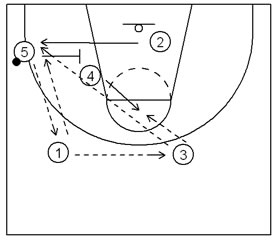
#5 catches , fakes and then throws back out to #1.
After passing , #5 screens in for #2.
#2 uses the screen and cuts ou t to the corner.
#1 can pass fake and throw back down to #2 or make a pass over to #3 at the back side guard spot.
When #3 catches the ball, he will look in to the post and then for the skip pass to #2.
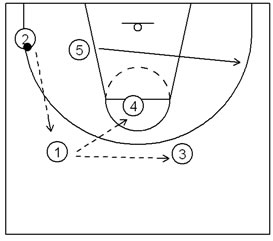
If #2 does not have a shot , or a pass to #5 , he will start ball reversal by passing out to #1.
#1 wil l look to #4 and then over to #3.
When #3 catches he will also look to get the ball into #4.
Note : when #1 and #3 both look to feed the post , #5 has more time to make his cut and get into position to receive the ball.
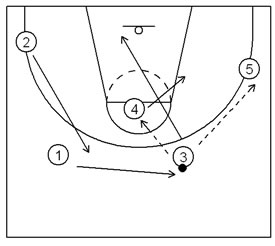
After #3 makes the pass down to #5 , he will cut down to the back side block.
#4 will search the ball and try to free himnself in the in the post area.
#1 and #2 will rotate one spot toward the ball.
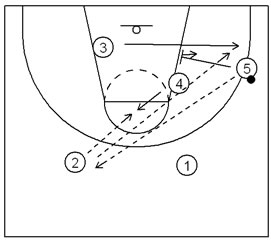
In this diagram, #5 throws a skip pass to #2.
After passing he screens in for #3.
#3 uses the screen and cuts to the corner.
When #2 catches, #4 flashes back looking for the ball.
Again , #2 catches, looks into the post , and then for the skip pass to #3.
#2 can also make the pass to #1 and #1 can throw down to #3 in the corner.